Guide
What Is an Invoice? Meaning, Purpose and Examples
By PDF Invoice Pro · Published

The short answer
An invoice is a document a seller sends to a buyer to request payment for goods or services that have been supplied. It lists what was provided, the price, any tax, the total owed and when payment is due, and it gives both sides a record of the sale for their accounts and taxes.
What an invoice is for
An invoice does three jobs at once. It asks for payment — it is the document that starts the clock on your payment terms. It records the sale, so you can prove what you earned and your customer can prove what they spent. And it settles the details — quantities, prices and dates — so nobody has to remember what was agreed.
That record matters at tax time. The IRS lists invoices among the supporting documents that back up the income and expenses on a return (IRS: what kind of records should I keep), and in the UK an invoice has to carry specific details, set out by GOV.UK.
What an invoice includes
The details vary by country, but almost every invoice carries the same core information:
| Part | What it is | Example |
|---|---|---|
| Invoice number | A unique reference, usually sequential | INV-2026-0042 |
| Invoice date and due date | When it was issued and when payment is due | Issued 1 Mar, due 31 Mar (Net 30) |
| Seller details | Your name or business name, address, contact details, tax ID if you have one | Northwind Studio, VAT GB123456789 |
| Buyer details | Who is paying, and their billing address | Acme Ltd, Accounts Payable |
| Line items | What was supplied, quantity and rate | Logo design — 1 × $1,200 |
| Subtotal, tax and total | The arithmetic, with tax shown separately | Subtotal $2,300, tax 8% $184, total $2,484 |
| Payment terms and method | When and how to pay | Net 30, bank transfer or card |
For a step-by-step walk through each field, see how to write an invoice. If you need a consistent numbering format, the invoice number generator previews one before you commit to it.
When do you send an invoice?
Usually after the goods are delivered or the work is done, because an invoice says money is now owed. There are common exceptions:
- Deposits: a deposit invoice is sent before work starts, for an agreed share of the price.
- Milestones: long projects are invoiced in stages — the project payment schedule calculator lays out the dates and amounts.
- Recurring work: retainers and subscriptions are invoiced on a fixed cycle.
- Before shipping goods abroad: a proforma invoice is sent first, as a quote in invoice form.
The due date is the invoice date plus the payment term. An invoice dated 1 March on Net 30 is due on 31 March — the invoice due date calculator works it out for any term.
Types of invoice
| Type | Used for |
|---|---|
| Standard (sales) invoice | A one-off sale of goods or services |
| Proforma invoice | A quote in invoice format, sent before the sale is final |
| Deposit invoice | An upfront part-payment before work starts |
| Interim or milestone invoice | One stage of a longer project |
| Final invoice | The balance once a project is complete |
| Recurring invoice | The same charge on a regular cycle |
| Credit note | Reduces or cancels an invoice that was already issued |
| Commercial invoice | Customs document for goods shipped internationally |
Invoice vs. receipt, quote and purchase order
An invoice is easy to confuse with the documents around it. A quote offers a price before the work. A purchase order is the buyer’s authorisation to buy. The invoice asks for payment once the sale has happened. A receipt confirms that payment arrived. The full comparison is in invoice vs. receipt.
An invoice example
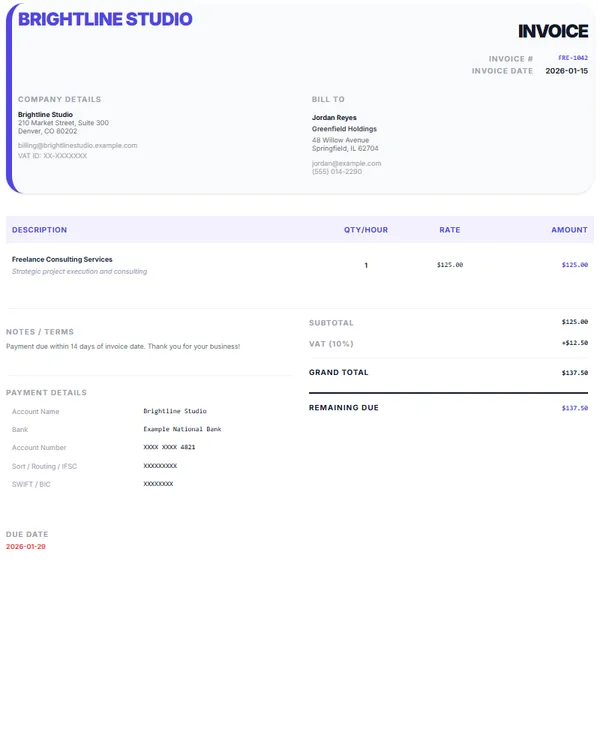
A design studio bills a client for a logo ($1,200), brand guidelines ($800) and 4 hours of revisions at $75 ($300). The subtotal is $2,300. With 8% sales tax ($184), the total due is $2,484, payable within 30 days.
You can make one like it in the free invoice generator: add your logo, enter the lines, choose a design and download a PDF. There is no sign-up and no watermark. If you prefer to start from your trade’s typical line items, pick one of the industry invoice templates.
Frequently asked questions
What is the main purpose of an invoice?
To request payment for goods or services that have been supplied, and to record the sale for both the seller and the buyer. It states what is owed, by when and how to pay.
Is an invoice issued before or after payment?
Normally before payment and after delivery: the invoice is what asks for the money. A receipt is the document issued after payment. Deposit and proforma invoices are the main cases sent before the work or shipment.
Does an invoice mean it has been paid?
No. An invoice shows an amount that is owed. It is only settled once payment arrives, at which point you can mark it paid or issue a receipt. Many invoices show an “amount paid” line and a remaining balance for part-payments.
Can I refuse to pay an invoice?
You can dispute an invoice that is wrong — for work that was not done, the wrong price or a duplicate. Raise it with the seller quickly and in writing. Refusing a correct invoice for work you agreed to is a breach of the agreement; the rules depend on your contract and country.
What is a red flag on an invoice?
A new or changed bank account, a sender address that does not match the supplier, pressure to pay urgently, missing invoice numbers or vague descriptions. Confirm changed payment details by phone using a number you already have before paying.
Make your invoice now
Free invoice generator: no sign-up, no watermark. Add your logo and tax, then download a PDF.
Open the invoice generatorKeep going
 GuideHow to Write an Invoice (Step by Step, With an Example)
 GuideInvoice vs. Receipt: What’s the Difference?
Invoice templates
Sources
- What kind of records should I keep — IRS
- Invoicing and taking payment from customers: what invoices must include — GOV.UK
- Pro forma invoice — International Trade Administration
General information, not legal, tax or financial advice. Rules differ by country.