How to Add Tax to an Invoice: VAT, GST & Sales Tax Explained Simply
How to add tax to an invoice the right way: VAT, GST, HST, and US sales tax explained, with correct labeling, multiple tax rates, and worked examples.
Where Tax Goes on an Invoice (The Universal Structure)
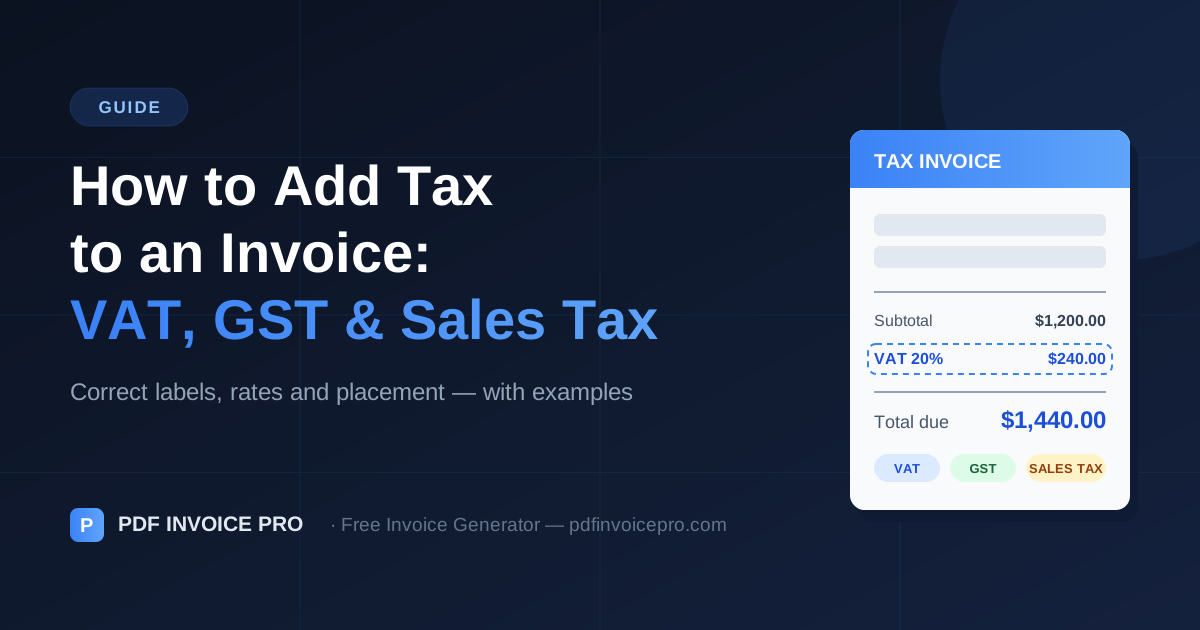
Whatever country you invoice from, the tax section of an invoice has one correct shape, and it looks like this: an itemized list of what you're charging, a subtotal of those items before tax, one or more clearly labeled tax lines showing the tax name, the rate, and the calculated amount — and then the grand total the client actually pays.
The load-bearing word is labeled. "Tax — $190" is weak; "VAT 20% — $190" tells the client, their bookkeeper, and any future auditor exactly what was charged and lets them verify the arithmetic in their head. Most tax systems don't merely prefer this — they require the rate and amount to be visible for the invoice to count as valid tax documentation.
Two structural rules complete the picture. First, calculate tax on the subtotal after any discount, not before — a $1,000 job with a $100 discount is taxed on $900. Second, if you're not registered for (or not required to charge) a given tax, don't print a zero-filled tax line "just in case"; an invoice with no tax line is cleaner than one implying a registration you don't have.
VAT vs GST vs Sales Tax: Which World Are You In?
Three families of consumption tax cover most of the planet, and your invoice obligations depend on which one applies to you — usually determined by where your business is registered, with wrinkles for cross-border work.
VAT (Value-Added Tax) — the UK, EU, and much of the world. Charged at every stage of the supply chain; registered businesses charge it on sales and reclaim it on purchases. Registration is mandatory above a revenue threshold that varies by country.
GST (Goods and Services Tax) — Australia, New Zealand, India, Singapore, and Canada (where it coexists with provincial taxes as GST/HST/PST). Mechanically similar to VAT with local labeling and rules.
US Sales Tax — the outlier: a state-and-local retail tax charged only at the final sale, with no reclaim mechanism and enormous variation in what's taxable, especially for services and digital goods.
The invoice consequence: VAT and GST invoices carry your registration number and per-rate tax detail as legal requirements. US invoices carry sales tax only when your state and service category require it — which for many service freelancers means no tax line at all.
US Sales Tax for Freelancers: The Honest Answer
The honest answer is "it depends on your state," and here is how to resolve it for yourself in under an hour. Most states exempt most professional services — writing, design, consulting, development — from sales tax. But a substantial minority tax specific service categories, and a growing number tax digital products (stock files, templates, software licenses) even when custom services are exempt. And if you sell to clients in other states at real volume, "economic nexus" rules can eventually pull you into their systems too.
The practical sequence: search your state revenue department's site for your service category, note whether digital deliverables are treated differently from custom work, and confirm once with a local accountant. Then encode the answer in your invoice template and move on. What you shouldn't do is charge tax "to be safe" — collecting a tax you're not registered to remit creates its own problem.
Not charging sales tax doesn't mean the income is untaxed — you still owe income and self-employment tax on every invoice. That side of the ledger is covered in our guide to tax documentation for freelancers.
VAT Invoices: What Makes One Valid
If you're VAT-registered, your invoices graduate into legal documents with a checklist. A valid VAT invoice generally must show: your VAT registration number, the invoice date and a unique invoice number, your and the client's names and addresses, a description of the goods or services, and — per rate — the net amount, the VAT rate, and the VAT amount. Miss the registration number and your client may be unable to reclaim the VAT, which they will notice quickly.
Cross-border sales inside the VAT world add one more pattern worth knowing: B2B services between VAT countries often shift the tax obligation to the buyer (the "reverse charge"), in which case your invoice shows 0% VAT plus a note like "VAT reverse-charged to recipient — Art. 196 EU VAT Directive." The mechanics differ by country pair, and our guide to invoicing international clients walks through the common cases.
GST Invoices: Australia, India, Canada
Australia: registered businesses (threshold: AUD 75,000 revenue) issue "tax invoices" showing the ABN, the GST amount (10%), and the words "Tax Invoice" for sales over AUD 82.50. Below the threshold you don't charge GST at all.
India: GST splits by geography. Within a state, the rate divides into two equal lines — CGST and SGST (e.g. 9% + 9%). Between states, a single IGST line carries the combined rate. Registered businesses show their GSTIN, and the correct split is a validity requirement, not a style choice.
Canada: a federal GST (5%) combines with provincial taxes differently by province — harmonized into a single HST line in some (Ontario: 13%), charged as separate GST + PST lines in others (British Columbia). The label on your invoice must match your province's structure.
The common thread: the tax label is jurisdiction-specific and matters. This is exactly why our free invoice generator lets you rename the tax field to anything — VAT, GST, HST, CGST/SGST/IGST, Sales Tax, or a custom label — and set any rate, rather than forcing a US-centric "Tax" line on everyone.
Handling Multiple Tax Rates on One Invoice
Real invoices mix rates more often than you'd think: a standard-rated service beside a zero-rated export; a taxable digital product beside an exempt consultation; CGST and SGST as parallel lines by design. The rule is always the same — one tax line per rate, each labeled with its own percentage, each calculated on its own portion of the subtotal.
What you must avoid is blending: a single "Tax — $147" line that secretly averages two rates cannot be verified by anyone, including the tax authority evaluating your client's reclaim. If the rates differ, the lines split. Generators handle the arithmetic; your job is just to assign the right rate to the right item.
Three Worked Examples
UK freelance designer (VAT 20%): Logo design £900 + brand guidelines £300 → subtotal £1,200 → "VAT 20% — £240" → total £1,440, with the VAT number in the header.
Indian consultant, intra-state (GST 18%): Consulting fee ₹50,000 → subtotal ₹50,000 → "CGST 9% — ₹4,500" + "SGST 9% — ₹4,500" → total ₹59,000, GSTIN shown.
Texas web developer (services exempt): Website build $3,000 → subtotal $3,000 → no tax line → total $3,000. Clean absence, not a zero-filled line.
Setting Tax Up Correctly Takes Five Minutes
Everything above compresses into a one-time setup: know which tax family you're in, know whether you're registered (or required to charge at all), pick the correct label and rate, and place it between subtotal and total on every invoice. In PDF Invoice Pro that's a tax field you configure once — custom label, any rate, percentage or flat, multiple lines when you need them — and every subsequent invoice inherits the correct treatment automatically.
Tax on invoices is one of those topics that feels intimidating precisely until it's configured, and then it's invisible. Spend the five minutes, confirm the local wrinkle with your accountant if you have one, and let the invoice do the remembering.
Sources & Further Reading
Alex Carter is a freelance finance writer specialising in invoicing, cash flow management, and small business operations. He has written for independent contractors and agencies across the US, UK, and Australia.
Ready to create professional invoices?
Free, private, no account needed. Create your first invoice in 60 seconds.
Create Free Invoice