Invoice Payment Terms Explained: Net 30, Net 15, Due on Receipt & More
Invoice payment terms explained in plain English: Net 30, Net 15, Due on Receipt, 2/10 Net 30 and more — which to choose, and the exact wording to use.
What Payment Terms Actually Are (And Why They Decide When You Get Paid)
Payment terms are the part of an invoice that answers one question: by when must this be paid? They sound like fine print, but they're closer to a lever. The same $1,500 invoice can turn into cash in three days or thirty-five depending entirely on the two or three words you print next to "Terms."
Here's what most freelancers learn the hard way: clients don't pay when they receive an invoice. They pay when the invoice tells them to — or, more precisely, when their payment process encounters your due date. An invoice with no stated terms gets dropped into the "whenever" pile. An invoice that says "Due June 15" gets scheduled.
Payment terms also do quiet legal work. If a client pays late and you ever need to charge interest, send a formal demand, or pursue the debt, the stated terms are your reference point. No terms, no baseline. That's why every professional invoice — including the ones you build in our free invoice generator, which prints both a terms field and a calculated due date — treats terms as a required field, not a nice-to-have.
Common Payment Terms, Decoded
The vocabulary is small, but each term carries different expectations. Here's the full set you'll actually encounter:
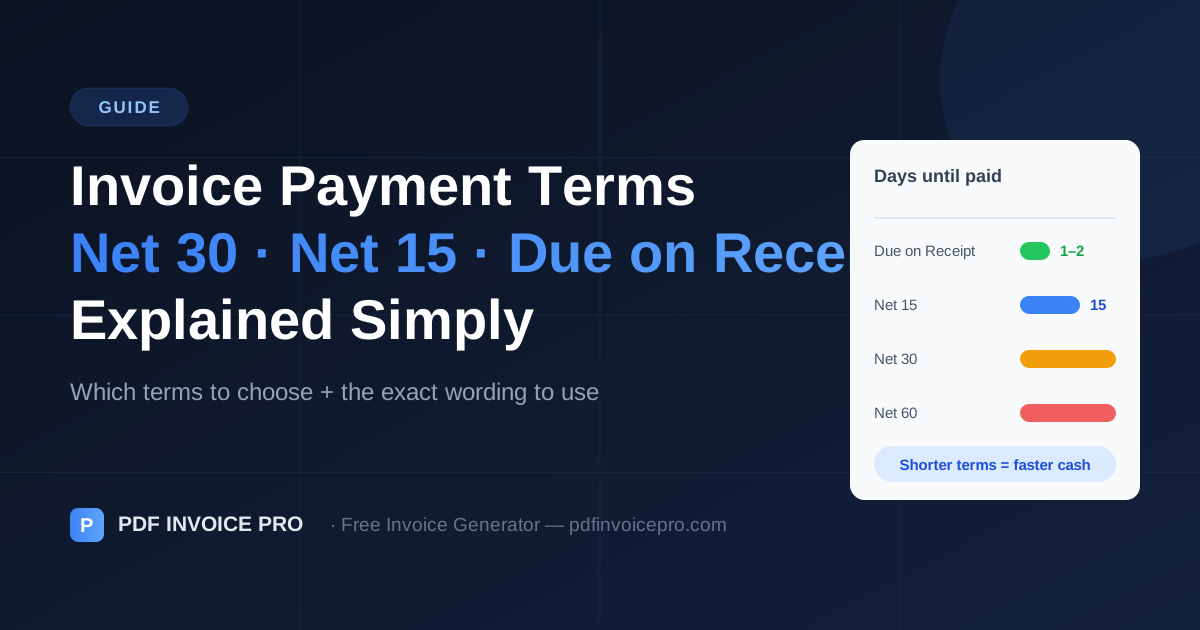
Due on Receipt. Payment is expected as soon as the client receives the invoice — in practice, within a day or two. Best for small jobs, first-time clients, and any situation where the work is already delivered. It's also the standard for one-off services under a few hundred dollars.
Net 7 / Net 10 / Net 15. Payment is due 7, 10, or 15 calendar days from the invoice date. Net 15 has quietly become the sweet spot for freelance services: short enough to protect cash flow, long enough that no reasonable client objects.
Net 30. The corporate default — due 30 days after the invoice date. Common with agencies, mid-size companies, and anyone with a formal accounts-payable department. More on why you shouldn't automatically accept it below.
Net 60 / Net 90. Enterprise territory. Some large companies impose these unilaterally. They're really asking you to finance their operations for two or three months — if you accept them, price that financing into your rate.
EOM (End of Month). Due at the end of the month the invoice was issued. An invoice sent June 3 and one sent June 27 both come due June 30 — which makes early-month invoicing strategically smart.
2/10 Net 30. A hybrid: 2% discount if paid within 10 days, full amount due in 30. It converts your patience into a price and lets the client choose.
50% upfront, 50% on delivery. Not a timing term but a structure term — and for projects over roughly $1,000, arguably the most important one in this list. It filters out non-serious clients before you've done any work.
The Truth About Net 30 (It Wasn't Designed for You)
Net 30 dates from an era of paper checks, mailed invoices, and monthly accounting runs. Large companies batched their payables once or twice a month, and 30 days gave everyone room for the paperwork to move. That world mostly no longer exists — but the habit survived.
For a freelancer or small business, Net 30 has a real cost. Say you invoice $4,000 a month and your average client actually pays at day 38 (Net 30 plus the typical delay). You are permanently floating roughly $5,000 of delivered-but-unpaid work. That's money that can't pay your rent, your software subscriptions, or your quarterly taxes — a direct hit to the cash flow problems we cover in our guide to cash flow management for freelancers.
Freelancers routinely assume Net 30 is mandatory. It isn't. Unless a signed contract specifies otherwise, you set your own terms. In practice, clients accept Net 15 without comment when it's stated from the first invoice — pushback almost always comes from changing terms mid-relationship, not from the terms themselves.
When should you accept Net 30? When the client is large enough that their AP process genuinely can't move faster, and valuable enough that the wait is worth it. In that case, treat the first invoice as a test: if it arrives on day 45 instead of day 30, you've learned what "Net 30" means to that client, and you can price or structure future work accordingly.
How to Choose the Right Terms for Each Client
There's no single correct answer — there's a correct answer per situation. A useful decision pattern:
New client, small job: Due on Receipt. The relationship has no payment history, and the amount doesn't justify a collection cycle.
New client, large project: 50% deposit before work begins, remainder Net 15 on delivery. The deposit is your risk filter; the Net 15 keeps the tail short.
Established client, recurring work: Net 15, invoiced on a fixed day each month. Rhythm matters more than speed here — clients pay reliable invoices reliably.
Corporate client with an AP department: Net 30, but get a purchase order number and the AP contact's email on day one, and submit the invoice exactly the way their system wants. Half of "late" corporate payments are actually formatting rejections nobody told you about.
International client: Net 15 with payment method agreed in advance. Cross-border transfers add their own delays on top of your terms — our guide to invoicing international clients covers the details.
Early-Payment Discounts: Buying Speed With Margin
An early-payment discount like 2/10 Net 30 is a straightforward trade: you give up a small slice of revenue to collect weeks sooner. Whether it's worth it depends on what faster cash is worth to you.
The math on a $3,000 invoice: the 2% discount costs you $60. In exchange, you receive $2,940 up to 20 days earlier. If cash is tight — you're covering expenses on a credit card, or delaying your own purchases — $60 for three weeks of liquidity is cheap. If your cash buffer is healthy, skip the discount and keep the margin.
Two rules make discounts work in practice. First, put the deadline in concrete dates, not just shorthand: "2% discount if paid by June 11 ($2,940). Full amount due July 1 ($3,000)." Second, apply it consistently — a discount that appears and disappears between invoices trains clients to negotiate every bill.
Late Fees: The Clause You Hope Never to Use
A late fee's real job isn't revenue — it's making "pay on time" the path of least resistance. The standard structure is 1.5% per month (18% annually) on overdue balances, which is high enough to notice and low enough to stay enforceable in most places.
Three requirements for a late fee to hold up:
- Disclose it before the work begins. A fee that first appears on the invoice itself is easy to dispute. Put it in your contract or accepted quote, then repeat it on every invoice.
- State it precisely. "A late fee of 1.5% per month applies to balances outstanding past the due date" beats "late fees may apply" in every way that matters.
- Apply it predictably. You can always waive a fee as a goodwill gesture — that's a gift. Charging one that was never clearly established is a fight.
Some jurisdictions cap late-payment interest or require specific disclosure language, and rules differ for consumer versus business clients. If you invoice across borders, verify the cap in the client's country, not just yours.
Exact Wording You Can Copy
Terms fail when they're vague. These formulations are unambiguous and print-ready:
- "Payment Terms: Net 15. Due date: June 16, 2026."
- "Due on receipt. Please pay within 2 business days."
- "50% deposit due before project start; remaining 50% due Net 15 upon delivery."
- "2% early-payment discount if paid by June 11 ($2,940). Full amount $3,000 due July 1."
- "Overdue balances accrue a late fee of 1.5% per month, as agreed in our contract dated March 3, 2026."
- "Accepted payment methods: bank transfer (details below), card via payment link, PayPal."
Notice the pattern: every line pairs the term with a number and a date. When you build an invoice in our generator, set the due date field and the terms text together — the printed due date is what actually drives payment behavior.
Enforcing Terms Without Burning Relationships
Terms only matter if something happens when they're missed. The good news: enforcement is mostly rhythm, not confrontation. A due-date-minus-3 reminder, a due-date-plus-1 nudge, and a firm but polite follow-up at plus-7 will collect the large majority of late invoices before anything escalates. We've written the exact messages for each stage — including copy-paste templates — in our guide to past-due invoice emails.
The tooling helps more than willpower does. PDF Invoice Pro's dashboard includes an Urgency Radar that watches every saved invoice against its due date and flags anything due within 48 hours in amber and anything overdue in red — then lets you fire a pre-written reminder via Gmail or WhatsApp in one click. You set the terms once; the system remembers them so you don't have to.
Start with your very next invoice: pick the term that fits the client, print the due date beside it, and state your payment methods. That's the entire discipline — and it's usually worth more than any single price increase you'll make this year.
Sources & Further Reading
Alex Carter is a freelance finance writer specialising in invoicing, cash flow management, and small business operations. He has written for independent contractors and agencies across the US, UK, and Australia.
Ready to create professional invoices?
Free, private, no account needed. Create your first invoice in 60 seconds.
Create Free Invoice