How to Write a Past-Due Invoice Email That Gets Paid (7 Templates)
How to write a past-due invoice email that actually gets paid. 7 copy-paste payment reminder templates, from friendly nudge to final notice, plus timing rules.
Why Invoices Go Unpaid (It's Rarely What You Think)
When an invoice sails past its due date, the mind goes straight to the worst explanation: the client is dodging you. Occasionally that's true. But the boring reality is that most late payments are logistics, not malice. The invoice landed in a spam folder. The person who approves payments was on vacation. Your PDF is sitting in an inbox with 4,000 unread messages. The client's own client paid late, and the shortfall rolled downhill to you.
This matters because the explanation determines the tone. If 80% of late payments are administrative friction, then 80% of your reminders should read like friendly operational messages — clear, brief, and easy to act on — not like the opening move of a dispute. Writing angry emails at day 2 burns relationships that a two-line nudge would have preserved. Writing timid emails at day 40 loses money that a firm one would have collected.
The skill, then, is escalation: starting soft, getting firmer on a fixed schedule, and never skipping steps. The rest of this guide gives you the schedule and the exact words.
The Reminder Timeline That Collects Most Invoices
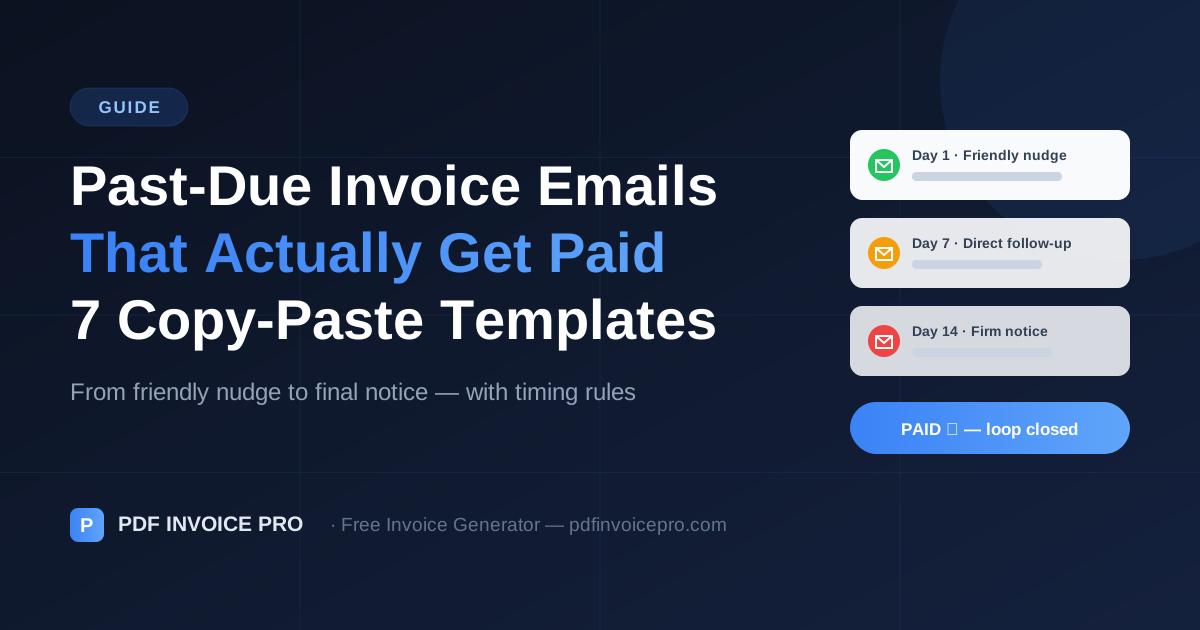
Effective follow-up runs on the calendar, not on your mood. Here's the sequence used in some form by nearly every business with healthy receivables:
- 3 days before due: a pre-due courtesy note. Prevents the "oh, I forgot" category entirely.
- 1 day after due: the first reminder. Light, factual, assumes oversight.
- 7 days after due: the second reminder. Still polite, now asks a direct question and requests a payment date.
- 14 days after due: the firm reminder. States consequences (late fee, work pause) that were previously agreed.
- 21–30 days after due: the final notice. Sets a hard deadline and names the next step.
Two observations from businesses that track this: first, the pre-due note alone eliminates a third or more of late payments. Second, most invoices that get paid late are paid after the day-1 or day-7 message — the deep-escalation steps exist for a small minority of cases, but their existence is what makes the early steps credible.
The hardest part of the sequence is remembering to run it. PDF Invoice Pro's Urgency Radar does the watching for you: every saved invoice is checked against its due date, with amber flags at 48 hours before due and red flags once overdue — and a one-click pre-written reminder via Gmail or WhatsApp when a flag appears.
Anatomy of a Payment Reminder That Works
Every effective reminder — regardless of stage — shares five traits:
1. The subject line does the work. "Invoice #142 — due June 15 ($1,850)" outperforms "Following up" because it's actionable from the inbox list, before the email is even opened.
2. All the facts, zero hunting. Invoice number, amount, original due date, and payment methods — in the body, every time. Never make the client dig through old emails to figure out how to pay you; every minute of friction is a day of delay.
3. The invoice is re-attached. Assume the original is lost. Attaching it again costs nothing and removes the most common honest excuse.
4. One clear ask. "Could you confirm when payment will be sent?" is a question that gets answered. "Just checking in on this" is a statement that gets archived.
5. Brevity. Four sentences beats four paragraphs at every stage. Long reminders read as emotional; short ones read as operational.
The 7 Copy-Paste Templates
Template 1 — Pre-due courtesy (3 days before):
Subject: Invoice #142 — due this Friday ($1,850)
"Hi Sarah, a quick heads-up that invoice #142 for $1,850 is due this Friday, June 15. The invoice is attached with payment details included. Let me know if anything is needed on my end. Thanks!"
Template 2 — First reminder (1 day overdue):
Subject: Invoice #142 — past due as of yesterday
"Hi Sarah, invoice #142 for $1,850 was due yesterday (June 15) and I haven't seen it come through yet. I've re-attached it here — bank details and the payment link are on the invoice. If it's already been sent, please ignore this. Thanks!"
Template 3 — Second reminder (7 days overdue):
Subject: Invoice #142 — one week past due
"Hi Sarah, following up on invoice #142 ($1,850), now a week past its June 15 due date. Could you confirm when payment will be sent? If there's an issue with the invoice or a delay on your side, tell me and we'll sort it out. Invoice attached again for convenience."
Template 4 — Firm reminder (14 days overdue):
Subject: Invoice #142 — two weeks overdue, action needed
"Hi Sarah, invoice #142 ($1,850) is now two weeks overdue. As set out in our agreement, a late fee of 1.5% per month applies to overdue balances, and I'll need to pause work on the current phase until the invoice is settled. Please arrange payment or reply with a firm payment date by Friday."
Template 5 — Final notice (21–30 days overdue):
Subject: FINAL NOTICE — Invoice #142, $1,850
"Hi Sarah, despite several reminders, invoice #142 ($1,850, due June 15) remains unpaid. If payment isn't received by July 20, I'll have to refer the balance for formal collection, which I'd much rather avoid. Please treat this as urgent — I'm available today by phone if there's anything to discuss."
Template 6 — WhatsApp nudge (any early stage):
"Hi Sarah! Quick reminder — invoice #142 ($1,850) went past due on June 15. Payment link and bank details are on the invoice (PDF in your email). Could you take a look this week? Thanks! 🙏"
Template 7 — The relationship-saver (when they finally pay):
"Received — thank you! Receipt attached, invoice #142 is marked paid in full. Looking forward to the next phase."
Closing the loop graciously matters: clients remember how the ending felt, not how firm Template 4 was.
Email, WhatsApp, or Phone — Which Channel When?
Email is the default: it's documented, professional, and attachable. Every stage of the sequence belongs on email even if you also use another channel, because the paper trail is what protects you at the escalation stage.
WhatsApp or SMS shine for speed with clients who live in chat. A short message gets read in minutes. Use it as a supplement at day 1 and day 7 — "just flagged this by email too" — rather than a replacement. PDF Invoice Pro generates the message text for either channel directly from the overdue invoice, pre-filled with the number, amount, and due date.
Phone calls are the day-14+ tool. A call is harder to ignore than any written message and instantly distinguishes "disorganized" from "avoiding you." Stay factual, take notes, and follow up with an email summarizing what was agreed — the call creates the commitment; the email records it.
When (and How) to Escalate Beyond Reminders
If the final notice deadline passes silently, you have four options, in rough order of cost: a formal demand letter (surprisingly effective — templates exist, or a lawyer will send one for a modest flat fee), mediation through a small-business or freelancer association, small-claims court (designed for exactly this, no lawyer needed in most places, fees are modest), and collection agencies (typically 25–50% contingency; a last resort for balances worth the haircut).
One rule across all of them: your written trail is your case. The invoice with clear payment terms, the sequence of dated reminders, the client's replies — that's what turns "he said, she said" into a straightforward claim. Which is one more reason to run the reminder sequence in writing even when you'd rather just call.
Preventing the Next Late Payment
Collection is a skill; prevention is a system. The businesses that rarely chase invoices do four things consistently: they agree on terms before work starts, they invoice immediately on delivery (every day of invoicing delay adds roughly a day of payment delay), they make paying frictionless — payment link, QR code, and bank details all on the invoice — and they send that pre-due courtesy note.
Most of that is invoice construction, which is the part you fully control. Build the invoice with a printed due date, explicit terms, and every payment method you accept — our free invoice generator does all of it in about a minute, and the dashboard's radar handles the remembering. Get those pieces in place and the templates above become something you rarely need past stage two — and if the mistakes that cause disputes interest you, our rundown of common invoicing mistakes pairs well with this guide.
Sources & Further Reading
Alex Carter is a freelance finance writer specialising in invoicing, cash flow management, and small business operations. He has written for independent contractors and agencies across the US, UK, and Australia.
Ready to create professional invoices?
Free, private, no account needed. Create your first invoice in 60 seconds.
Create Free Invoice