Deposit Invoices: How to Ask for Upfront Payment (Without Losing Clients)
How to create a deposit invoice and ask for upfront payment confidently: how much to charge, exact wording, deposit vs retainer, and handling pushback.
Why Deposits Change Everything About Freelancing
Ask experienced freelancers what single policy most improved their business, and a surprising number give the same answer: requiring a deposit before starting work. Not a pricing change, not a new marketing channel — a payment structure.
The reasons stack. A deposit converts a verbal "yes" into a financial commitment, which is the moment a project becomes real. It filters out the clients who were never going to pay well — the ones who vanish at the word "deposit" would have vanished at the final invoice too, except by then you'd have done the work. It funds the project's own expenses instead of your credit card. And psychologically, it changes the relationship: a client with money already invested treats deadlines, feedback rounds, and your time with noticeably more respect.
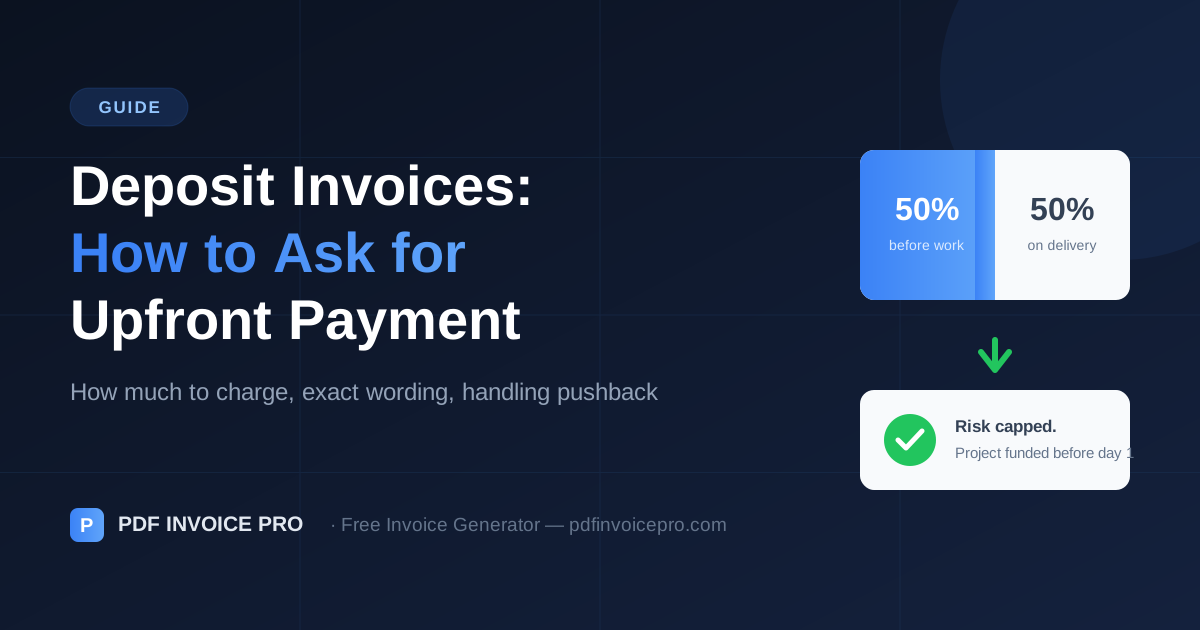
Perhaps most importantly, a deposit caps your downside. On a $4,000 project with 50% down, the worst-case scenario — total client disappearance — costs you $2,000 of unpaid work instead of $4,000. Deposits are the closest thing freelancing has to insurance, and the premium is a single slightly-awkward sentence in your proposal.
How Much to Ask For (And When to Deviate From 50%)
50% upfront, 50% on delivery is the industry default across design, development, writing, photography, and consulting — common enough that most business clients expect it and no reasonable one is surprised by it. When in doubt, ask for half.
Deviate deliberately, not timidly:
- 100% upfront for small jobs (roughly under $500), where splitting payments costs more admin than it saves risk — and for clients with a history of slow payment.
- Higher than 50% when the project front-loads your costs: materials, stock licenses, travel, subcontractors. The deposit should at minimum cover everything you must spend before delivery.
- 25–33% for large projects with established clients, usually as the first slice of a milestone schedule (a third up front, a third at midpoint approval, a third on delivery).
- First-time clients: whatever your normal percentage is — plus extra firmness. The first project is exactly when you have zero payment history to rely on.
Deposit vs Retainer vs Milestone Billing
Three structures get conflated constantly, and using the wrong word in a proposal creates confusion later.
A deposit is a one-time partial prepayment tied to a single defined project, credited against that project's final invoice. A retainer is recurring — a monthly fee that either reserves your availability or prepays a block of hours; it renews and isn't tied to one deliverable (we cover the invoicing rhythm for retainers in our recurring invoices guide). Milestone billing splits one large project into several payments triggered by defined stages — effectively a series of deposits, each unlocking the next phase.
Pick by project shape: single project → deposit. Ongoing relationship → retainer. Large multi-month build → milestones. All three share the same principle: money arrives before or alongside the work, never entirely after.
Building the Deposit Invoice Itself
A deposit invoice is a real invoice, not an informal request — it gets its own number in your sequence, a due date, and full payment details. The distinguishing features are in the line item and the terms:
- Line item wording: "Deposit — 50% of agreed project total ($4,800) for website redesign, per proposal dated May 2, 2026." One line, fully self-explanatory.
- Terms: "Due on receipt. Project work begins upon payment." That second sentence is the entire mechanism — it makes the deposit the project's ignition key rather than a favor.
- Reference forward: a note such as "Remaining 50% ($2,400) will be invoiced on delivery" so the client's accounting sees the full picture from day one.
If the client needs a formal document before committing — for internal approval or budgeting — send a proforma invoice for the full amount first, then the actual deposit invoice once they say go. Building either takes about a minute in our free invoice generator: same template, different title and line item.
The Final Invoice: Showing the Deposit as a Credit
When the project completes, the final invoice must tell the whole financial story, or the client's bookkeeper will email you asking why the numbers don't match the proposal. The correct structure: show the full project value as the line items, then subtract the deposit as a clearly labeled credit line, then show the balance due.
Website redesign — $4,800. Less: deposit received May 5 (invoice INV-2026-041) — −$2,400. Balance due: $2,400.
Note that the credit line references the deposit invoice's number and payment date — that cross-reference is what makes the two-invoice pair audit-proof, and it takes ten seconds to include. If you charge tax, apply it to the full project value on the final invoice (with the deposit credited after tax, matching however tax was handled on the deposit invoice — keep the two consistent).
How to Ask for a Deposit Without Feeling Awkward
The awkwardness dissolves when the deposit stops being a request and becomes how you work. You're not asking permission; you're describing your process — the same way a hotel describes check-in time.
In a proposal: "Payment terms: 50% deposit to begin work, remaining 50% on delivery. I'll send the deposit invoice once you approve this proposal — work starts as soon as it's paid."
In conversation: "Great — I'll send over the deposit invoice for half, and I'll get started the moment it lands."
Deposits land best when they appear in the proposal, before any negotiation. Introducing one after a client has mentally "bought" at full-price-later feels like a change of deal — the same sentence placed one conversation earlier feels like standard procedure, because it is.
Handling Pushback (And Reading It Correctly)
"Can we do 25% instead?" — a negotiation, and a legitimate one. Counter with milestones if the total is large, or accept if the client is established. You've still got commitment.
"Our company pays all invoices Net 30 after delivery, no exceptions." — common with larger corporations, and often genuinely true of their AP systems. Options: accept it for a client whose payment reliability is verifiable, price the waiting into your rate, or propose a compromise (a smaller deposit processed as its own PO). See our guide to payment terms for the corporate-client playbook.
"We don't pay anything before seeing the work." — from an individual or small business with no AP constraints, this is the red flag of red flags. The polite exit: "I understand — my process does require a deposit, so it sounds like I might not be the right fit for this one." The projects you lose to that sentence are disproportionately the ones that would have ended in our past-due email templates anyway.
Refunds, Cancellations, and Other Edge Cases
Decide your refund policy before the first deposit arrives, write it into the contract, and echo one line of it on the deposit invoice. A structure that's fair in both directions: refundable minus work already performed if the client cancels before a defined stage; non-refundable once that stage begins (because you've reserved capacity and declined other work). If you cancel, the unearned portion goes back — full stop, reputation is worth more than any deposit.
Scope changes deserve the same pre-agreement: the deposit anchors to the original scope, and material additions get their own quote and, for large additions, their own deposit. Handled this way, the deposit isn't just risk protection — it's the document that keeps everyone honest about what was agreed. Set the structure once, put the sentence in your proposal template, and let every future project start on the right foundation.
Sources & Further Reading
Alex Carter is a freelance finance writer specialising in invoicing, cash flow management, and small business operations. He has written for independent contractors and agencies across the US, UK, and Australia.
Ready to create professional invoices?
Free, private, no account needed. Create your first invoice in 60 seconds.
Create Free Invoice