How to Add a Discount to an Invoice (And When You Actually Should)
How to show a discount on an invoice correctly: percentage vs fixed amount, before or after tax, exact wording, and the discounts that help vs hurt your business.
Where a Discount Goes on an Invoice (Anatomy First)
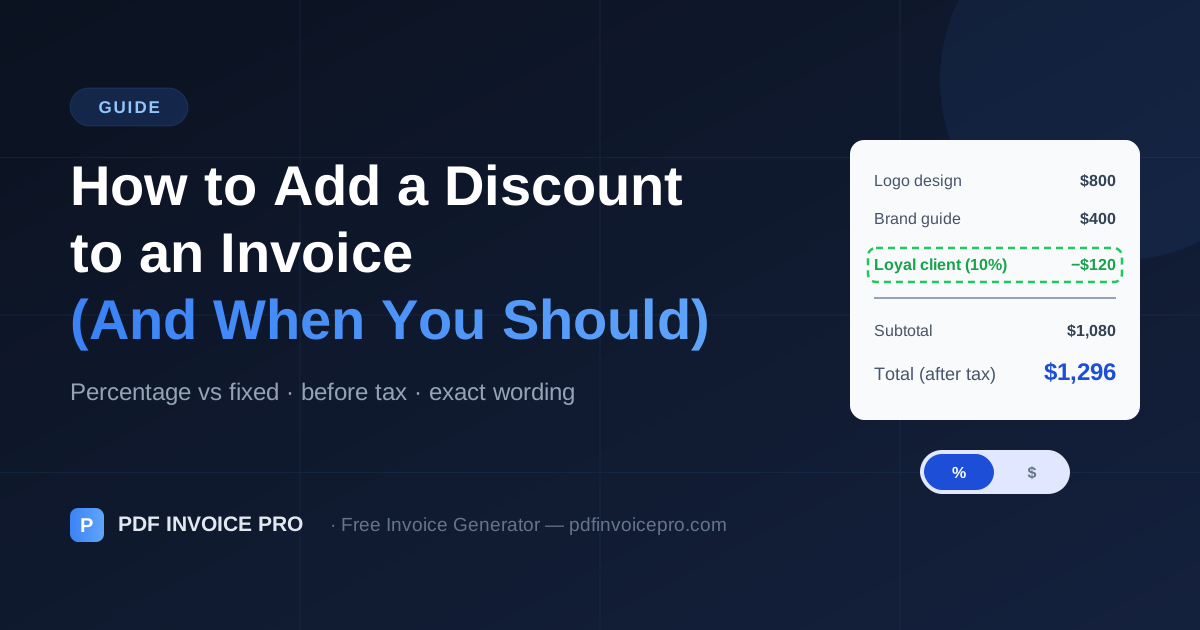
A discount done right is visible three times on the invoice: the client sees what the work is worth, sees what they're saving, and sees why. The structure that achieves this is universal:
List every line item at its full price. Below the items, add a labeled discount line with the reason and the math: "Discount — early payment (2%): −$48." Then show the subtotal after discount, then tax calculated on that subtotal, then the total.
What you should never do is quietly reduce the line-item prices themselves. It feels simpler, but it destroys the information: the client's records now say your logo design costs $720 (not $800 with a one-time reduction), the discount becomes invisible and therefore unappreciated, and next quarter's "why is the price higher than last time?" email writes itself. The visible discount line is simultaneously generosity and a receipt proving your real rate.
Percentage vs Fixed Amount: Choosing the Right Type
Both types are legitimate; they communicate differently and fit different reasons.
Percentage discounts scale with the invoice and attach naturally to relationships and behaviors: a 10% loyal-client rate, a 15% nonprofit rate, 2% for early payment. Because the amount grows with the work, a percentage feels like a standing status the client has earned — appropriate when that's exactly what you mean to convey.
Fixed-amount discounts attach to specific events: "−$150 referral credit," "−$200 goodwill adjustment for the delayed delivery," "−$300 prepaid credit from deposit overage." The concrete number reads as a discrete transaction, done and closed — which is what you want when the reduction should visibly not be a precedent.
A practical wrinkle: on small invoices, percentages sound trivial ("5% off $200 is... $10?") while fixed amounts stay legible; on large invoices the reverse. Match the type to the reason first, the size second. In our free invoice generator, the discount field toggles between percentage and fixed modes, so the invoice mechanics never constrain the choice.
Discounts and Tax: One Rule, Always
Tax is calculated on what you actually charge — the post-discount amount. A $1,000 project with a 10% discount is a $900 sale; VAT, GST, or sales tax applies to $900. Sequence on the invoice: items → discount → subtotal → tax → total.
Getting this backwards (taxing $1,000, then discounting) overcharges the client's tax and misstates your own remittance. Every serious invoicing tool, ours included, hard-codes the correct order — the rule matters mainly when you're checking someone's spreadsheet math or building invoices by hand in Word. For the fuller tax picture (labels, rates, multi-rate invoices), see how to add tax to an invoice.
The Four Discounts That Actually Help Your Business
1. Early-payment discounts (1–2% within 7–10 days). The classic "2/10 Net 30" converts margin into cash-flow speed at a price you control. It works because the decision-maker is often the client's finance team, and finance teams are professionally incapable of ignoring a discount. Details and math in our payment terms guide.
2. Prepayment/retainer discounts. "10% off when you prepay the quarter" trades margin for guaranteed, front-loaded revenue — usually a winning trade for a freelancer whose real enemy is income volatility.
3. Volume/bundle discounts with explicit thresholds. "Four posts monthly at $360 each vs $400 one-off" rewards commitment you can plan around. The threshold does the negotiating for you.
4. Strategic one-time credits, labeled as such. A referral credit, a launch-client rate, a make-good after a hiccup on your side. These buy goodwill precisely because the invoice shows them as exceptional.
Notice the pattern: each one purchases something specific — speed, certainty, volume, goodwill. A discount with a purchase behind it is pricing strategy.
The Discounts That Quietly Hurt You
The pressure discount — knocked off simply because the client hesitated. It teaches that your quote is an opening bid, guaranteeing harder negotiation on every future project. If a budget is genuinely short, cut scope, never just price (more below).
The recurring "one-time" discount. A courtesy 10% that appears on three consecutive invoices is no longer a discount; it's your new rate, minus the honesty. If the relationship merits a standing rate, formalize it as one.
The unexplained discount. A bare "−$100" line invites the worst interpretation: that the price was invented. Every discount line carries its reason — three or four words suffice.
The desperation discount. Discounting to fill a dry pipeline compounds the problem: it fills your calendar at the exact moment you can least afford margin loss, with clients selected specifically for price sensitivity. The sustainable fixes live in pricing your services correctly.
At typical freelance margins, a 10% discount often erases 15–25% of the actual profit on a project. Run the number on your own cost structure once — most freelancers who do become noticeably more selective about which discounts they offer.
Exact Wording You Can Copy
- "Discount — early payment (2% if paid by June 11): −USD 48"
- "Loyal client rate (10%): −$180"
- "Referral credit — thank you for introducing Acme Co: −$150"
- "Quarterly prepayment discount (10%): −$540"
- "Goodwill adjustment — delivery delay on our side: −$200 (one-time)"
- "Nonprofit rate (15%): −$330"
Each line names the type, shows the math, and — where it matters — marks the reduction as one-time. Thirty seconds of wording prevents entire categories of future negotiation.
Before You Discount: Three Alternatives That Protect Your Rate
Cut scope, not price. "I can meet that budget by trimming the deliverables to X and Y" solves the client's constraint while your hourly value stays intact — and frequently the client finds the money for full scope once the trade-off is concrete.
Add value instead of subtracting price. A bonus revision round or an extra deliverable costs you marginal time, reads as generosity, and leaves the price anchor untouched.
Trade the reduction for something. A testimonial, a case-study permission, a referral, prepayment. "I can do 10% off if we can feature the project in my portfolio" turns a concession into a transaction.
Discounts are a tool — sharpest when they're rare, explained, and structurally correct on the invoice: full prices shown, labeled reduction, tax on the discounted subtotal. Build one that way in the generator — toggle percentage or fixed, and the math and placement are handled — and your generosity will read exactly as intended, with your rate's integrity fully intact.
Sources & Further Reading
Alex Carter is a freelance finance writer specialising in invoicing, cash flow management, and small business operations. He has written for independent contractors and agencies across the US, UK, and Australia.
Ready to create professional invoices?
Free, private, no account needed. Create your first invoice in 60 seconds.
Create Free Invoice